Wednesday, October 6, 2010

MODERN ART


II.

CHARACTERISTICS OF MODERN ART


Munch: Expressionism

Paul Klee


In view of this diversity, it is difficult to define modern art in a way that includes all of 20th-century Western art. For some critics, the most important characteristic of modern art is its attempt to make painting and sculpture ends in themselves, thus distinguishing modernism from earlier forms of art that had conveyed the ideas of powerful religious or political institutions. Because modern artists

were no longer funded primarily by these institutions, they were freer to suggest more personal meanings. This attitude is often expressed as art for art's sake, a point of view that is often interpreted as meaning art without political or religious motives. But even if religious and government institutions no longer commissioned most art, many modern artists still sought to convey spiritual or poli

tical messages. Russian painter Wassily Kandinsky, for instance, felt that color combined with abstraction could express a spiritual reality beneath ordinary appearances, while German painter Otto Dix created openly

political works that criticized policies of the German government.


Another theory claims that modern art is by nature rebellious and that this rebellion is most evident in a quest for originality and a continual desire to shock. The term avant-garde, which is often applied to modern art, comes from a French military term meaning “advance guard,” and suggests that what is modern is what is new, original, or cutting-edge. To be sure, many artists in the 20th century tr

ied to redefine what art means, or attempted to expand the definition of art to include concepts, materials, or techniques that were never before associated with art. In 1917, for example, French artist Marcel Duchamp exhibited everyday, mass-produced, utilitarian objects—including a bicycle wheel an

d a urinal—as works of art. In the 1950s and 1960s, American artist Allan Kaprow used his own body as an artistic medium in spontaneous performances that he declared to be artworks. In the 1970s American earthwork artist Robert Smithson used unaltered elements of the environment—earth, rocks, a

nd water—as material for his sculptural pieces. Consequently, many people associate modern art with what is radical and disturbing. Although a theory of rebellion could be applied to explain the quest for originality motivating a great number of 20th-century artists, it would be difficult to apply it to an artis

t such as Grant Wood, whose American Gothic clearly rejected the example of the advanced art of his time.


Another key characteristic of modern art is its fascination with modern technology and its embrace of mechanical methods of reproduction, such as photography and the printing press. In the early 1910s Italian artist Umberto Boccioni sought to glorify the precision and speed of the industrial age in his paintings and sculptures. At about the same time, Spanish painter Pablo Picasso incorporated newspaper clippings and other printed material into his paintings in a new technique known as collage. B

y the same token, however, other modern artists have sought inspiration from the spontaneous impulses of children’s art or from exploring the aesthetic traditions of nonindustrialized, non-Western cultures.

  1. ORIGINS:

    Impressionism

    Modern art's celebration of art for art's sake was initiated by French artists associated with impressionism, including Edouard Manet, Claude Monet, Edgar Degas, and Berthe Morisot. Abandoning direct references to religious and historical subjects, many of the impressionists broke away from the French art establishment in the 1870s and exhibited their paintings independently, anticipating the modern desire for independence from established institutions. In painting scenes of everyday life, especially life in local bars and theaters, the impressionists anticipated modern art's interest in popular culture. In depicting railroads, bridges, and examples of the new cast-iron architecture, they anticipated modern art's fascination with technology. And by pioneering new artistic techniques (that is, applying paint in small, broken brush strokes) and by intensifying their colors, they anticipated the modern fascination with originality. By exhibiting quickly executed works as finished paintings, they forced the public to reconsider the sketch, no longer as a preliminary exercise, but as an end in itself, thereby anticipating the tendency of modern artists to change and expand the definition of art.


Post-impressionism


Crows in a Wheatfield


In the last two decades of the 19th century a number of artists who had been inspired by the impressionists’ style and technique reacted strongly against the impressionist example. These artists, who were eventually called postimpressionists, established a number of alternate approaches to painting, each of which was to have remarkable repercussions for 20th-century art. Paul Gauguin, for instance, rejected the impressionist technique of applying touches of color in separate, small brushstrokes in favor of using large areas comprised of a single color bound by heavy contour lines. This innovation had an impact on Matisse and scores of later artists who used color as an expressive device rather than as a means for copying nature. In 1891 Gauguin decided to settle on the Pacific island of Tahiti, motivated by a desire to leave Western civilization and embrace a simpler form of existence. His work there contributed to the modern fascination with non-Western art.


Dutch painter Vincent van Gogh, a friend of Gauguin, used both color and brushwork to translate his emotional state into visual form. In addition, he infused his paintings with religious or allegorical meanings (black crows as symbols of death, for example), countering the impressionists' emphasis on direct observation.


The Scream


The work of Norwegian painter Edvard Munch was based on the assumption that painting could sacrifice truth to nature for expressive purposes.


IV.

MODERN ART’S FIRST DECADES


Cultural historians have related the fragmentation of form in late-19th- and early-20th-century art to the fragmentation of society at the time. The increasing technological aspirations of the industrial revolution widened the rift between the middle and the working classes. Women demanded the vote and equal rights. And the view of the mind presented by the founder of psychoanalysis, Sigmund Freud, stipulated that the human psyche, far from being unified, was fraught with emotional conflicts and contradictions. The discovery of X rays, physicist Albert Einstein's theory of relativity, and other technological innovations suggested that our visual experience no longer corresponded with science's view of the world.

Not surprisingly, various forms of artistic creativity reflected these tensions and developments. In literature, James Joyce, T. S. Eliot, and Virginia Woolf experimented with narrative structure, grammar, syntax, and spelling. In dance, Sergey Diaghilev, Isadora Duncan, and Loie Fuller experimented with unconventional choreography and costume. And in music, Arnold Schoenberg and Igor Stravinsky composed pieces that did not depend on traditional tonal structure.

Music not only took its place among the most experimental of the arts, but it also became a great inspiration for visual artists. Many art critics in the late 19th and early 20th centuries were influenced by German philosophers Arthur Schopenhauer and Friedrich Nietzsche, who had proclaimed that music was the most powerful of all the arts because it managed to suggest emotions directly, not by copying the world. Many painters of the late-19th-century symbolist movement, including Odilon Redon and Gustave Moreau, tried to emulate music’s power of direct suggestion. By including abstract forms and depicting an imaginary, rather than an observable, reality in their paintings, Redon and the symbolists paved the way for abstract art.


The idea that art could approximate music is reflected in Henri Matisse's Red Room (Harmony in Red) (1909, State Hermitage Museum, Saint Petersburg, Russia), a painting whose subtitle is borrowed from musical terminology. From Gauguin, Matisse borrowed large areas of unvaried color, simplified shapes, and heavy contour lines. The simplicity of Matisse’s drawing style relates to Gauguin's fascination with the art of non-Western cultures. Matisse also employed the abstract designs of carpets and textiles, reinforcing the flatness of the painting rather than attempting to create the illusion of depth. His interest in these designs demonstrates the influence of forms of creativity not often associated with fine art.


Although Red Room was intended as a pleasing image of middle-class domesticity, Matisse’s manner of depiction was considered highly revolutionary, especially in the way he assigned intense colors to objects arbitrarily and not according to their appearance in nature. A scandalized contemporary critic declared Matisse and his fellow artists—André Derain, Maurice de Vlaminck, and Georges Braque (of France), and Kees van Dongen (of the Netherlands)—to be fauves (French for “wild beasts”). This derogatory term became the name of their movement. Fauvism lasted only from about 1898 to 1908, but it had an enduring impact on 20th-century art.


Nude Descending a Staircase, No. 2


Nude Descending a Staircase, No. 2
Nude Descending a Staircase, No. 2 (1912), by French Dadaist Marcel Duchamp, is a synthesis of two modern-art styles: cubism and futurism. In creating this painting, Duchamp may have been influenced by the French photographer Eadweard Muybridge’s experiments with movement. The piece also shows Duchamp’s interest in machinery.
Encarta Encyclopedia
© 2008 Artists Rights Society (ARS), New York / ADAGP, Paris / Estate of Marcel Duchamp/Bridgeman Art Library, London/New York


Full Size


The futurists, a group of Italian artists working between 1909 and 1916, shared Léger's enthusiasm for technology, but pushed it even further. As their name suggests, the futurists embraced all that glorified new technology and mechanization and decried anything that had to do with tradition. They declared a speeding automobile to be more beautiful than an ancient Greek statue.


Futurist Sculpture


Futurist Sculpture
In his 1913 bronze statue Unique Forms of Continuity in Space Italian futurist Umberto Boccioni tried to show how a human body interacted with its environment as it moved. This sculpture is in the Tate Gallery in London, England.
Encarta Encyclopedia
Tate Gallery/Art Resource, NY


Full Size


In combining Picasso's fragmentation of form with Seurat's pointillist painting technique, Dynamism of a Soccer Player (1913, Museum of Modern Art, New York City) by Umberto Boccioni is typical of futurism. But the most noticeable feature of Boccioni’s many-legged soccer player is its depiction of motion. To achieve this sense of motion, the futurists drew upon sequential photographs of human movement by photographer Eadweard Muybridge and scientist Etienne-Jules Marey. 'A galloping horse,' the futurists proclaimed, 'has not four legs but twenty.' Like Léger, the futurists believed that a new society could be built only if citizens sacrificed their individuality for the good of the larger group. The new ideal human being suggested in Boccioni's painting would be more machine than man: strong, energetic, impersonal, even violent. Other futurist painters are Giacomo Balla, Carlo Carrà, and Gino Severini.


G. New Objectivity

War by Otto Dix


War by Otto Dix
This dark vision of the horrors of war by German artist Otto Dix reflects the artist's experience as a soldier in World War I (1914-1918). Dix led an artistic and literary movement called the Neue Sachlichkeit (“new objectivity”), whose members sought to present an often harsh view of reality. The triptych War (1929-1932) is in the Gemäldegalerie, in Dresden, Germany.
Encarta Encyclopedia
© 2008 Artists Rights Society (ARS), New York / VG Bild-Kunst, Bonn./Bridgeman Art Library, London/New York


Full Size


Twilight
German-born artist George Grosz is known for merciless caricatures of his fellow Germans, and he was among the first German artists to openly criticize the Nazi party. Twilight (1922, Museo Thyssen-Bornemisza, Madrid, Spain) depicts the indifference of the well-to-do toward a wounded veteran who has been reduced to begging.
Encarta Encyclopedia
© Estate of George Grosz/Licensed by VAGA, New York, NY. Photo: Scala. Art Resource, NY


Full Size


After the unprecedented devastation of World War I (1914-1918), some artists lost faith in abstraction. In particular, many came to believe that abstract art looked trivial and superficial when so many millions of people had lost their lives, entire cities were coping with food shortages and political corruption, and these cities were overrun by soldiers crippled during the war. In Germany artists belonging to a movement known as the Neue Sachlichkeit (new objectivity) believed that to address these problems art should no longer divorce itself from everyday experience, pursue abstract philosophical ideals, or probe the individual psychology of its creator. These artists, who included George Grosz and Otto Dix, advocated a return to more traditional modes of representation along with direct engagement with the pressing social and political issues of the time. Dix's Matchseller (1920, Staatsgalerie, Stuttgart), for example, rejects cubism, expressionism, and abstraction in favor of a more immediately comprehensible kind of representation. Addressing the insensitive treatment of soldiers who had risked their lives for their country, this painting shows a crippled soldier selling matches on the street as passersby pointedly ignore him. Dix was aware that the postwar treatment of veterans depended on their social class. Thus his image denounced not only war in general but also the specific social tensions that were dividing Germany at that time.


The slaughter of World War I affected artists in different ways. Some felt, as Mondrian did, that human betterment lay in the creation of an impersonal, mechanistic way of life, whereas others agreed with Dix that it lay in drawing attention to political problems. Still others concluded that the very idea of human betterment was a pointless illusion. For this group, the main lesson of the war, if anything, was the bankruptcy of reason, politics, technology, and even art itself. On this premise, several artists and poets founded a movement whose name, dada, was purposely meaningless, and whose members ridiculed anything having to do with culture, politics, or aesthetics. Centered at first in Zürich, Switzerland, dada later spread to Berlin, Paris, and New York City. Among its members were German poet Hugo Ball, German artist Kurt Schwitters, Romanian poet Tristan Tzara, Romanian artist Marcel Janco, American artist Man Ray, and French artists Jean Arp, Marcel Duchamp, and Francis Picabia. The dadaists attacked the idea of art or poetry by creating collage constructions from discarded junk, such as Kurt Schwitters’s Painting with Light Center (1919, Museum of Modern Art, New York City). They also would write satirical poems by picking words out of a hat. Chance and accident were among the dadaists’ most common creative devices.

An early and particularly influential dada work is Marcel Duchamp's Fountain (1917, Museum of Modern Art, New York City), an ordinary, mass-produced urinal that has been transformed into a work of art simply by being exhibited in a gallery and receiving a new title. Duchamp wished to ridicule traditional ideas of art, creativity, and beauty. The artist (although Duchamp always denied being “an artist”) would no longer create works of aesthetic merit based on inspiration or talent, but would select prefabricated everyday objects. And although these objects, which Duchamp dubbed ready-mades, had originally been functional, Duchamp denied their utilitarian function by putting them in a new context—a gallery or museum—and by changing their title.


Surrealism

The dadaists’ radical critique of art and reason had a strong appeal for an artistic and literary movement that was founded in 1924: surrealism. The surrealists, however, wanted to put a more positive spin on dada's pessimistic message. They were inspired by the writings of Freud, who had argued that the human mind was split between the conscious mind and the inaccessible unconscious mind, where a person’s innermost thoughts, feelings, and desires lay repressed. The surrealists set out to gain access to these private wishes and feelings through dream imagery, random association of words, and art. The artists seeking ways of accessing the unconscious mind included André Breton, André Masson, and Yves Tanguy of France, René Magritte of Belgium, Joan Miró and Salvador Dalí of Spain, and Max Ernst of Germany.

Two distinct styles emerged within surrealism. Some artists, such as Dalí and Magritte, attempted to suggest dream imagery by depicting objects accurately, but juxtaposing them in an irrational manner. An example of this strategy is Dalí’s The Persistence of Memory (1931, Museum of Modern Art, New York City). In this painting, pocket watches hang limply from a dead branch, while insects, a tabletop, and a distorted face lie in a barren landscape that leads back to a seashore and cliffs. The merging of these incongruous elements suggests an alternative, or a sur-reality, as the movement’s name implies.

Other surrealists attempted to allow the hand to wander across the canvas surface without any conscious control, a technique they called automatism. The automatists reasoned that if the conscious mind were allowed to relax its hold, the unconscious could begin to manifest itself. The lines of the painting would then be motivated not by the conscious mind, which conforms to social convention and training, but by the powerful store of emotions hidden in the unconscious. Automatism began with Paris surrealists, such as Picabia, Arp, and Masson, but in the 1940s gained a strong following in New York City and in Montréal, Canada. André Masson’s Panic (1963, Musée Nationale d’Art Moderne, Paris) is more abstract than the dream imagery of Dalí, though it nonetheless invites the viewer to examine its complex surfaces in search of visual clues to hidden meanings. These are meanings that Masson may not have intended but that he believed were nonetheless connected to his innermost emotions and desires.


A. Abstract Expressionism


Beta Upsilon


Full Size


During the late 1940s a movement called abstract expressionism began to develop in the United States under the influence of surrealist ideas, especially the desire to tap into the unconscious through the technique of automatism. Abstract expressionists emphasized the process of painting, by allowing evidence of the artist’s gestures to remain visible on the canvas surface. Among the leaders of this movement were Jackson Pollock, Franz Kline, Willem de Kooning, Robert Motherwell, and Hans Hofmann. Abstract expressionist paintings such as Pollock's Autumn Rhythm (1950, Metropolitan Museum of Art, New York City) give the impression of unprecedented spontaneity and physical energy. They also introduced all-over composition, in which visual marks are distributed in such a way as to produce no visual center of attention. In addition to surrealism, the abstract expressionists were influenced by Kandinsky’s ideas about similarities between abstract art and music and the ability of abstraction to communicate meaning and emotional content.

Other abstract expressionists, including Mark Rothko, Adolph Gottlieb, Clyfford Still, Ad Reinhardt, and Barnett Newman, chose a different approach. Instead of emphasizing the act of painting, they created images composed of large expanses of color and simplified forms. Barnett Newman, for instance, used a single vertical stripe to divide an otherwise solid field of color in his Onement I (1948, Museum of Modern Art, New York City). The image seems simple, but Newman saw it as symbolic of the vulnerability of humanity (the stripe) before nature (the field).


Sunday, October 3, 2010

Gothic art


The word "Gothic" for art was initially used as a synonym for "Barbaric", and was therefore used as a negative term of opprobrium: this type of Medieval art was considered as unrefined and barbaric, too remote from the aesthetic proportions and shapes of Classical art and its resurgence during the Renaissance.

Architecture
Gothic architecture is most familiar as the architecture of many of the great cathedrals, abbeys and parish churches of Europe. It is also the architecture of many castles, palaces, town halls, guild halls, universities and to a less prominent extent, private dwellings.


Gothic architecture grew out of the previous architectural genre, Romanesque. For the most part, there was not a clean break, as there was later to be in Renaissance Florence with the revival of the Classical style by Brunelleschi in the early 15th century.

Characteristics of Gothic churches and cathedrals

Plan

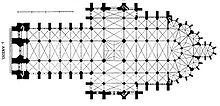
Most Gothic churches, unless they are entitled chapels, are of the Latin cross (or "cruciform") plan, with a long nave making the body of the church, a transverse arm called the transept and, beyond it, an extension which may be c

alled the choir, chancel or presbytery. There are several regional variations on this plan.

The nave is generally flanked on either side by aisles, usually singly, but sometimes double. The nave is generally considerably taller than the aisles, having clerestory windows which light the central space.


Light

One of the most distinctive characteristics of Gothic architecture is the expansive area of the windows as at Sainte Chapelle and the very large size of many individual windows, as at York Minster, Gloucester Cathedral and Milan Cathedral. The increase in size between windows of the Romanesque and Gothic periods is related to the use of the ribbed vault, and in particular, the pointed ribbed vault which channeled the weight to a supporting shaft with less outward thrust than a semicircular vault.

Greek Classical Period (480 - 323 B.C.)


The Classical period of Ancient Greece produced some of the most exquisite sculptures the world has ever seen. The art of the Classical Greek style is characterized by a joyous freedom of movement, freedom of expression, and it celebrates mankind as an independent entity (atomo). During this period, artists begin to expand the formal aesthetic boundaries while they worked in expressing the human figure in a more naturalistic manner. They were able to replace the strict asymmetry of the figure with a free flowing form more true to life, while they approached an ideal aesthetic vision through stone and bronze.

Architecture in ancient Greece:
Greek life was dominated by religion and so it is not surprising that the temples of ancient Greece were the biggest and most beautiful.They also had a political purpose as they were often built to celebrate civic power and pride, or offer thanksgiving to the patron deity of a city for success in war.

* Greek Temple Architecture

The Greeks developed three architectural systems, called orders, each with their own distinctive proportions and detailing. The Greek orders are: Doric, Ionic, and Corinthian.


The Doric style is rather sturdy and its top (the capital), is plain. This style was used in mainland Greece and the colonies in southern Italy and Sicily.


The Ionic style is thinner and more elegant. Its capital is decorated with a scroll-like design (a volute). This style was found in eastern Greece and the islands.


The Corinthian style is seldom used in the Greek world, but often seen on Roman temples. Its capital is very elaborate and decorated with acanthus leaves.


Parthenon - temple of Athena Parthenos ("Virgin"), Greek goddess of wisdom, on the Acropolis in Athens. The Parthenon was built in the 5th century BC, and despite the enormous damage it has sustained over the centuries, it still communicates the ideals of order and harmony for which Greek architecture is known.